
· by Michael Blair, Nashville's Cleaning Service
In a Middle Tennessee bathroom, the fight against mildew never really ends. The room gets wet every day, and the EPA’s page on mold and health states the whole problem in one line: the key to mold control is moisture control. What shows up is the familiar set: black specks along the caulk line, dark grout in the shower, a pink or orange film on the tile and the curtain, and a musty smell that comes back soon after cleaning. Most of it is manageable with the right product and a better routine. The part that is not is a repair, and we will say where that line falls.
Is the pink or black growth in a shower mold?
The pink or orange film is not mold at all. It is a bacterial film, and two names come up. One is Serratia marcescens, which the CDC’s journal Emerging Infectious Diseases describes as abundant in damp environments and easy to find in shower corners and basins; its pink-orange-red color comes from a pigment called prodigiosin. The other is Methylobacterium, the main genus in pink bathroom biofilms sampled for a study in Microbes and Environments, which took its samples from shampoo bottles and the baskets that hold soap and sponges. The researchers called these films difficult to remove and quick to come back, so the bottles and the caddy get wiped along with the walls.
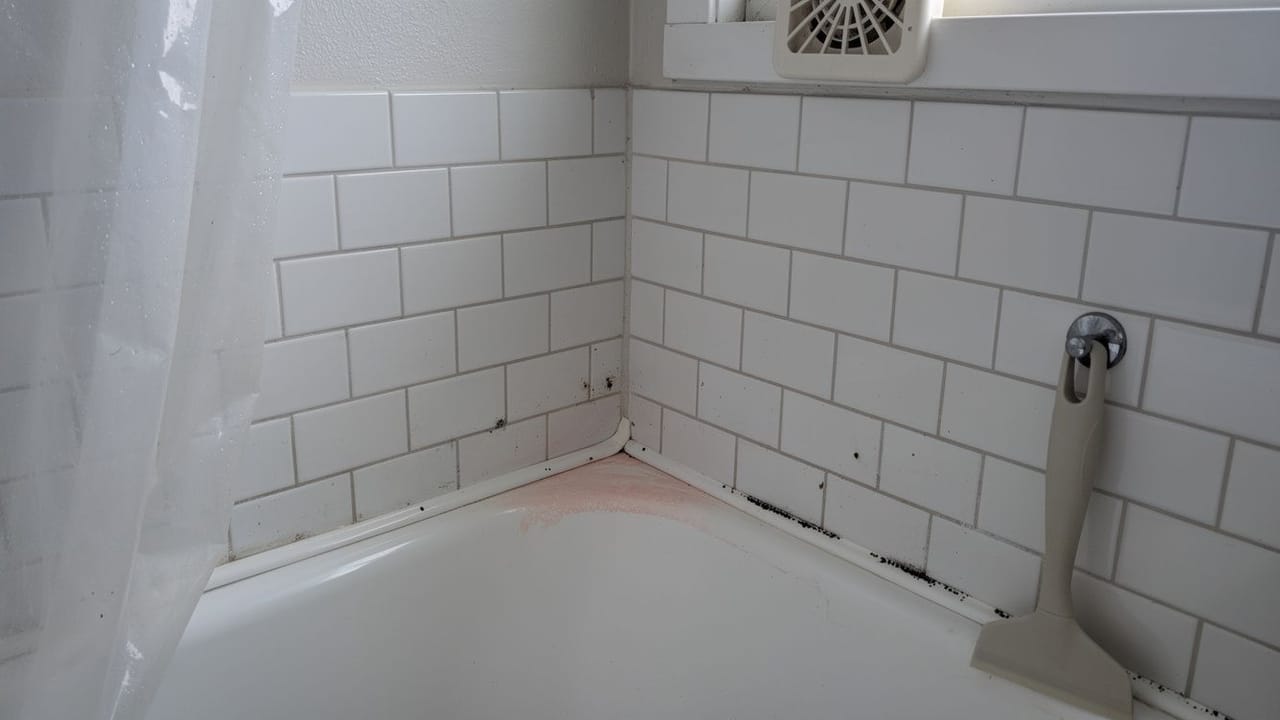
The black spots on grout and caulk and the dark growth in corners are mildew, which is mold. The musty smell is the mold too, and often a damp bath mat or a curtain that never gets the chance to dry. On a hard, non-porous surface such as tile, glass or a fiberglass surround, it sits on top, and the EPA’s basic mold cleanup steps say to scrub it off hard surfaces with detergent and water and dry them completely. Absorbent materials are another story; the same page warns that mold in them may be difficult or impossible to remove completely. Grout is unglazed, and on grout we expect to need more than one pass. Silicone caulk is where we find stains that no amount of scrubbing lifts.
What should bathroom mildew be cleaned with?
For routine cleaning, we use detergent and water or an ordinary bathroom cleaner with a stiff brush on the pink film and on light mildew, then dry the surface, which is the EPA’s method for hard surfaces. Bleach is optional. The EPA’s answer on using bleach for mold says a biocide such as chlorine bleach is not recommended as a routine part of mold cleanup, and that killing mold is not enough, because dead mold can still cause allergic reactions and has to be removed. If you do reach for bleach or a mildew remover on stubborn grout, follow the label, scrub the growth off afterward, rinse, and keep the room ventilated with the air going outdoors. The EPA’s brief guide to mold, moisture and your home also says to wear gloves, and with bleach it names gloves of natural rubber, neoprene, nitrile, polyurethane or PVC.
Never mix chlorine bleach with anything that contains ammonia; the EPA warns that toxic fumes could be produced. Our own rule is stricter. Bleach never shares a bucket or a wall with any other cleaner, vinegar-based products included: one product, a full rinse, and only then the next if it is needed. Marble, travertine and sealed grout get no vinegar from us; for natural stone we go by the stone or sealer maker’s care instructions rather than guess. Grout on a floor has its own problems, covered in our post on cleaning tile floors without wrecking the grout, and the white crust on shower glass is a mineral problem rather than a mold one, which is the subject of our post on Nashville hard water stains.
- Pink film: a bathroom cleaner and a brush, weekly, bottles and caddy included
- Grout mildew: detergent and water first, bleach only if needed, scrubbed off and rinsed
- Natural stone: the stone or sealer maker’s care instructions, nothing guessed
- Caulk that stays black after a proper cleaning: replace it
The caulk problem
Caulk along the tub, the shower base and the corners is where mildew is hardest to remove, because the stain sits under the surface of the bead. We clean it once, properly. If it is still dark after that, we stop scrubbing: the old caulk is cut out, the joint is cleaned and dried completely, and new caulk goes in, a silicone labeled mildew-resistant for kitchens and baths.
The dry step is the one people skip. The EPA’s mold cleanup page says not to paint or caulk moldy surfaces, and to clean up the mold and dry the surface first. A fresh bead run over a damp joint closes the moisture in behind it, which is exactly the condition mold needs. We leave the joint open with the fan running until it is dry to the touch and stays dry, and only then caulk.
Why does bathroom mold keep coming back?
Cleaning removes the growth; it does not change the conditions. The EPA’s bleach page makes the same point from the other side: a background level of mold spores will remain in any house, and those spores will not grow once the moisture problem has been resolved. For a shower where mold keeps reappearing, the EPA’s cleanup page suggests more ventilation, a running fan or an open window, and cleaning more often. A bathroom that mildews again within weeks of a deep clean is holding moisture too long.
Start with the fan. The Building America Solution Center’s guide to bathroom exhaust fans, from Pacific Northwest National Laboratory, recommends leaving it on for one hour after a shower, on a timer switch so nobody has to remember. It should pull hard enough to hold a tissue against the grille, and the duct should run directly outside, never into an attic or crawlspace. The same guide gives the minimum airflow as 50 cfm for a fan used intermittently or 20 cfm for one that runs continuously, and passes on ENERGY STAR’s advice to choose a fan rated at least 70 cfm for intermittent use.
The cheapest habit we suggest costs a few dollars: a squeegee on the glass and tile after each shower, and a bath mat hung up to dry instead of left on the floor. Both take water away before it can feed anything.
Growth on the ceiling, on the drywall behind the toilet or on the wall outside the shower is a different question. It means water is reaching porous material, from condensation or from a leak. The EPA’s mold course notes that mold is frequently found on walls in cold corners where condensation forms, and the EPA’s mold and health page says to fix leaky plumbing. Drywall is absorbent, and the cleanup page says absorbent materials that become moldy may have to be thrown away, so moldy drywall often has to be cut out and replaced. The EPA also puts the do-it-yourself limit at less than about 10 square feet, roughly a 3 by 3 foot patch; past that, or after a lot of water damage, it sends readers to its remediation guide. If you cannot tell which side of that line your bathroom is on, ask us to come and look.
Sources
- US EPA, Mold and Health — The key to mold control is moisture control; fix leaky plumbing; allergic reactions common; asthma episodes in sensitive people
- CDC, Emerging Infectious Diseases, Etymologia: Serratia marcescens (2019) — Abundant in damp environments, found in shower corners and basins; pink-orange-red pigment prodigiosin
- Microbes and Environments 28(1), Stress Tolerance of Methylobacterium Biofilms in Bathrooms (2013) — Methylobacterium the major genus in pink bathroom biofilms; sampled from shampoo bottles and soap baskets; difficult to remove, quick to recur
- US EPA, What are the basic mold cleanup steps? — Scrub mold off hard surfaces with detergent and water and dry completely; mold in absorbent materials may be impossible to remove
- US EPA, Should I use bleach to clean up mold? — Bleach not recommended as routine; dead mold must still be removed; ventilate; never mix bleach with ammonia; background spores will not grow once moisture is resolved
- US EPA, A Brief Guide to Mold, Moisture and Your Home — Wear gloves; glove materials for use with chlorine bleach
- US EPA, Mold Cleanup in Your Home — Do not caulk moldy surfaces; dry first; bathroom ventilation and more frequent cleaning; absorbent materials may have to be thrown away; about 10 square feet as the do-it-yourself limit
- Pacific Northwest National Laboratory, Building America Solution Center, Bathroom Exhaust Fans (2022) — Run the fan one hour after a shower on a timer; tissue test; vent outside, not into an attic; 50 cfm intermittent, 20 cfm continuous, ENERGY STAR 70 cfm
- US EPA, Mold Course Chapter 2 — Mold frequently found on walls in cold corners where condensation forms
FAQ
Cleaning Mold and Mildew in a Nashville Bathroom — questions
What is the pink stuff in my shower?
A bacterial film, not a mold. In bathrooms it is usually Serratia marcescens, which the CDC describes as common in shower corners and basins, or Methylobacterium, which a study of pink bathroom biofilms found on shampoo bottles and soap baskets. It can be stubborn to remove and comes back quickly, so clean the bottles and the caddy along with the walls and dry the shower after use.
Can I get black mold out of shower caulk?
Start with detergent, water and a brush, which is the EPA’s method for mold on hard surfaces. When the bead is still black after a proper cleaning, we stop scrubbing and replace it: the old caulk is cut out, the joint is cleaned and dried completely, and new mildew-resistant caulk goes in. The EPA advises against caulking over a moldy surface, which is why the drying step matters.
Is bathroom mildew dangerous?
For most people, ordinary mildew on tile and grout is a nuisance. The EPA says allergic reactions to mold are common and that mold can trigger asthma episodes in sensitive people, so anyone with allergies or asthma has more reason to keep it down. Growth on drywall, a ceiling or behind a fixture means water is reaching porous material, and the EPA says to fix plumbing leaks and other water problems as soon as possible.
What’s the difference between mold and mildew in a shower?
In a shower there is no real difference, because mildew is mold: the black specks on grout and caulk and the dark growth in the corners. The pink or orange film many people call mold is actually bacteria. On tile, glass and fiberglass, both come off with detergent, water and a brush, followed by a thorough drying.